
All technology, including the digital kind, is the product of a political ideology that is usually hidden.
During 2023, artificial intelligence was everywhere. We heard about it in a variety of spaces: artistic and creative, social research, medical, labor, and government. We heard about its potential, scope, biases, problems, aspirations, as well the “inevitability” of its presence.
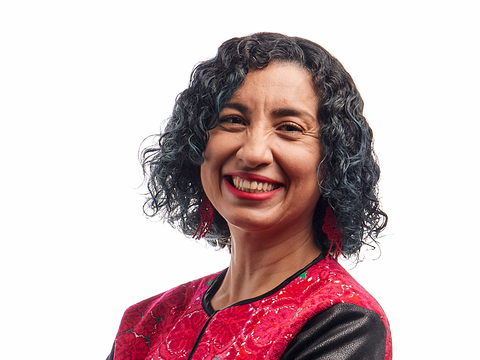
How and where do social movements position themselves in the face of these issues? How close are the problems but also the impacts and opportunities? In this conversation we invite Paola Ricaurte who recovers the notion of the coloniality of power to propose a vision of AI development that articulates the macro and micro-political aspects of technological development as part of a decolonial and feminist project.
Paola Ricaurte is an Associate Professor in the Department of Media and Digital Culture at Tecnológico de Monterrey, Faculty Associate at the Berkman Klein Center for Internet & Society at Harvard University, and co-founder of the Tierra Común network. She leads the Latin American and Caribbean hub of the Feminist AI Research Network.
Questions and discussion
Following are some of the questions and discussion from participants from the chat and the questions pad:
Is there a better term than AI since AI is not intelligence? integrated memory?
AI is a very unfortunate term for us, but is a highly productive term for the industry and those who are interested in constructing an imaginary of AI as a super powerful, unified technology. This term reflects the desires and aspirations of the white men often credited with creating the field and supporting the development of these technologies. Other terms are not so powerful in building this imaginary. In fact, many propose using “Machine Learning” instead of AI, because most of the time we are referring to this specific type of AI systems. AI as a concept is an oversimplification of a set of heterogeneous technologies that helps reinforce this constructed imaginary.
It is important to note that current “AI” is based on digital models (simulations) of how the organic, biological brain works, that is, the neural network. This does not work by logical operations, but by “training”, based on repeated exposure to many inputs, creating pattern recognition capability, but not enabling knowledge of what training data contributed to the training, or how much it contributed, or what aspects or elements of the training data stimuli enabled the pattern to be recognized. This is now focused on language processing “large language models”, or LLMs, that can be trained to sound like an intelligent person talking, but is just a statistically constructed assembly of language-like output. Emily Bender calls this “stochastic parrots”. But the tech could lend itself to much more valuable applications, if you think of it like training a dog (or a baby), how could we train an organizational model to support feminist egalitarian behavior in our work? How could we train such a system to support managing huge amounts of data generated by a community, in such a way that the community can use it to increase the community’s self-awareness, support community intentionality, by reflecting back the patterns the system finds emerging in the community’s collective interactions, both economic and social?
Do you see any liberatory potential for AI? If so, what use cases?
There is a reality we can’t ignore: the AI industry is currently controlled by a very small group of people with great power. It is difficult to even imagine how these individuals influence the economy, politics, legislation, research, and advocacy. For me, the question is, can we, our communities, develop technologies—including AI—that are built on values that are not market-driven and that allow people to be agents of their own destinies, achieving the right to live in dignity? And I think the answer is yes. The problem is, how do we create the conditions for people to take part in the development of the technologies they need? We need technologies that are governed, designed, produced, and maintained by those who have always been excluded from technological development and from society in general.
Can you imagine how an organization like Mayfirst could use AI to build community?
I guess it is a matter of collectively deciding and imagining how these technologies can enhance communities’ potential for transformation. For example, we are supporting a project in which indigenous communities are collecting data from their territories to help them understand the changes in the midst of deep water scarcity. They are developing tools based on community and ancestral ways to govern water and respond to their specific needs. I think every community should decide which technologies are good for them and for what purposes.
Can someone drop in the chat or followup email the names of the AI projects Paola shared that she and other communities are developing?
Our projects are published on the A+ Alliance website, but some of them have their own websites. For example: EDIA and Aymurai here and here. Additionally, we have a network called Tierra Común focused on fighting data colonization, and another project with the Mexican organization Sursiendo that explores the environmental consequences of tech development.
Are there any schools or organizations that offer technical training for communities to learn about AI,web3, programming, UX etc? Should organizations invest in this type of education for workers and participants?
These are huge interesting questions, and each of those are sort of different, if related areas of tech. That said, organizations have worked on aspects of this. Detroit Digital Justice, and Community Network Development Kit are some projects that folks in our orbit have worked on. As far as whether organizations should invest… I think this is an issue where the movement needs to invest in knowledge and infrastructure, but I don’t know that everyone needs this capacity to do their work, and different projects will approach this differently based on their work. The other resources question is if we want to do things with AI on movement owned hardware, we’re going to need to find more resources for people like Mayfirst. Finally, I’ve been starting to look into how to use/train/expand open source AI, and perhaps will be able to share what I learn)
I’m planning to investigate the utility of the opensource models on huggingface to see if we could build a reverse customer service model, where the organization’s people collectively train (via interaction and reinforcement) a model to help them in their work.
What can be strategies of resistance against AI colonialism that targets our thoughts, lives, culture and communities and alienates us from the real world, society and nature?
Historically, we have found many ways of resisting colonialism, violence, and exclusion. People around the world are resisting, at a very high cost, and in different ways. There are amazing examples everywhere, every day, of people putting their energy into sustaining life. I think that resistance is something fluid, heterogeneous, and dynamic. Sometimes it means organizing and demanding our rights as movements on the streets, and sometimes it means pausing to take care of ourselves and reconvening to join forces again. But if we are part of a movement, we must remember that resistance always needs to be a collective effort.
Do we really think that there is a way to “construct” a “good” artificial intelligence? Is it really possible to imagine a technology that doesn’t produce displacements, the destruction of the earth, data theft, slavery-like working conditions? And if instead of remaking/taking back the tools of the enemy, could we put our energies into rebuilding communities, relationships, individuals who “need” technologies less and less?
I totally agree that our energies should be especially focused on rebuilding our communities, our relationships with ourselves, others, and the environment. For me, the main problem that we are facing as humanity is the loss of understanding that we need each other to survive on this planet. My concern regarding AI is that these tools are being promoted as the dominant means to control societies and concentrate power and wealth. If we don’t react to this as movements, if we don’t oppose this AI regime, we risk waking up one day without the possibility of living in a way that is good for us and our communities.
The usability of AI for reterritorialization and urban expansions, modeling territories at the service of large financial and urban capital, affecting collective and environmental rights; used without control by municipal governments and business corporations without complying with the social and ecological function: only to make money.
But what can we do, it would be great to think about it in the framework of the coop, not just in the abstract: How can a coop like may first take advantage of AI?
The most common advice I hear, in liberatory struggles, is simply “organize, organize, organize”: what potential opportunities might there be to use AI to enable and enhance local and global organizing?
On what basis would we trust an ai fed and cared for by the hyper-capitalists?
In my opinion, we shouldn’t trust that AI.
So many opportunities to solve local/community level problems using AI and other tech/design tools - our communities are full of creative genius. Orgs like MayFirst can help create access to tools and expertise so we can support these type of micro projects. Hopefully scale the good ideas to more people and places.
I suggest people form small discussion groups to help each other learn about this complex tech as some people do not feel comfortable asking questions in large groups. We use Signal chat channels to do this.
Hola, thank you for this presentation. I’m sharing a link to a bunch of articles/reports/ recommendations related to generative AI and human rights from WITNESS (where I work) in case anyone is interested: https://www.gen-ai.witness.org/, looking forward to continuing this conversation and organizing!
Thank you.